Letter to the Princeton University WordNet Team about Manufactured Homes

April 10th, 2013 1 comment

(Editor's Note: This letter is reprinted with permission, and was sent in response to this blog post.)

Word Net Team,

Along with others involved in the manufactured housing industry, I have noticed that an incorrect definition for the term “manufactured home” has been published on the Internet and that the definition originated with your group.

Official, legal, definitions are available on many state and national government websites and I request that you update your own definition using one of these.  Most of these definitions established by Congress or the various state legislatures are similar to one another but if you need to combine some verbiage to accurately inform a national audience I’m sure you will be able to produce such a definition.  I encourage you to take action on this simple “fix” as soon as possible to avoid creating further confusion and misinformation among consumers on the most affordable and tightly regulated housing option in America.

Thank you,

Jody Anderson
President, Timberland Mobile Housing, LLC
1600 N. Timberland Drive
Lufkin, Texas  75901
936-632-4481

(Editor's Note: The email address for the WordNet team is: wordnet@princeton.edu  please consider sending them a message of your own, or use a variation on the one Jody Anderson sent above or that Tony Kovach sent linked again here.)

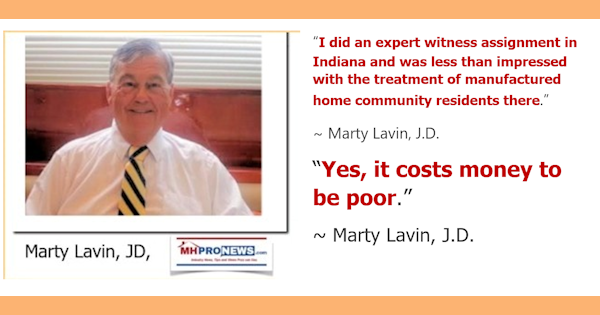
Interview with Marty Lavin, JD

April 3rd, 2013 1 comment

Marty, before we get into the meaty topics that will follow, let's establish your credentials for readers who may not know you and your background.

  • 1) MHProNews: Please tell us about your years involved in manufactured housing, including legal, as a community owner, expert on financing and any other. Include a sense of your MHC, financing and other business interests.

marty-lavin-50-posted-mhpronews-com-industry-voices-blog Marty Lavin:

I’m now 70 years old and I look back to 1972, when as a summer intern I entered the mobile home business. I was a junior in law school and was working at Ray’s Homes, who operated owned and franchised lots up and down the east coast, from New Brunswick to Florida.

For you youngsters, 1972 and then 1973 following it were the absolute pinnacle of the mobile home industry, reaching almost 580,000 shipments both years. At today’s shipments level, that is about eleven years of shipments, in each year, back to back. Those were giddy times, and predictions of 1,000,000 annual mobile home production seemed heady, but few seriously doubted it could happen, there seemed no barriers.

There were factories building homes all the way from some constructing them in their garage to the industry giants, Champion and Fleetwood or their compatriots. Time dims my full memory of 1972 and ’73, but not the excitement of those incredible times.

What it does not dim is that our sales organization was a national scope powerhouse, selling over 5,000 new homes in 1973. Think of that, almost 1% of all national sales, in one small outfit run by 3 people! I was proud of that then and still am.

What I remember most about 1972 is a time I was asked to go to a local land lease community owned by our organization. The community had about 214 homes in it, as I remember, a very large community in our small State of Vermont.

I was to field resident complaints. As I recall, a modest rent increase had just gone in and there was an uprising. I was to go up and quell the unrest.

I arrived at 5:30 PM, alone, at the community ballpark, and I met with 200+ very angry folks, and since they had been playing softball there were lots of baseball bats in the hands of the angry. Lesson: never attend a resident meeting alone with 200 angry people with baseball bats in hand. Actually a number of lessons came from that incident, which later served me well in both the MH Community and the apartment business. After all, the folks who inhabit apartments and MH Communities are not so different.

I came back after law school graduation and spent the next five years managing the legal affairs of sales lots, calling on banks for our service company, doing other legal work, and giving zoning presentations for MH Communities and strip shopping centers. Let’s say that the strip center zoning was easy compared with zoning MH Communities in most eastern states, as it was a serious challenge, even in the 1970’s. Always the endeavor was contentious, costly and endless, not a good business model.

By 1977 I became a General Motors dealer, selling Chevys for 4 years, then Oldsmobile and Cadillac for another 5 years. Sad to say, as much as I liked selling cars, I could not succeed financially although my sales were excellent, but profits, not sales volume sets the business paradigm, in cars or MH, and I fell short there. At the time the U.S. auto business was under serious pressure from the foreigns, and GM was already a doomed giant.

Back I went to real estate and the MH business.

From 1985 until 1995 I ran fast and hard buying communities in several states. As I remember at one point I was in George Allen’s top 75 list or thereabouts of community owners. These were communities I owned mostly on my own, few partners, just bank and seller debt. And of course, whether it is equity money from public subscription or money partners, or purchase money debt, they can all be harsh masters, and the vicious real estate depression of the 1989-1993 and the RTC (Resolution Trust Corporation) had us all in workouts. Most of my friends and partners declared bankruptcy. I thought that foolish, as it seemed unnecessary. Lots of talking and court appearances, but I got through it in spite of $55 million in debt, in 1989 dollars.

Rather than bankruptcy, my own course was entirely different. I chose to be prickly, but reasonable. Prickly, in that I could not be easily rolled by the creditor, and reasonable in that sometimes a property is not working, and it needs to go to someone with greater resources.

By 1988 I had formed an MH chattel loan service company, representing a large number of northeast area banks in originating loans, for home only, going primarily into communities. The general downturn of 1989-1993, with a steep decline in MH sales and lots of repossessions, stopped the service company’s climb to the big loan numbers. But they ultimately did come. In 1998, our company, Mortgage Services, Inc. (MSI) originated over 6,500 loans, totaling $188 million in originations. Those are big numbers in chattel loans by a broker. But as proud as we are of our volume, our record of clean paper without games, is a greater source of pride.

We originated loans for Vanderbilt, Chemical/Chase Bank, The Associates, CIT Group and many others. As one lender said to me a couple years after they left the industry and was running off the portfolio, “If every loan we bought were like yours, Marty, we’d still be in the business.” Satisfying words, indeed, in an industry enshrined in the Lending World Hall of Shame for Fraud.

We hung on with ever-smaller loan volume throughout most of the 2000’s, finally calling it quits after 2008, when we could no longer make money and my eyes glazed over trying to reinvent myself.

In 1999 or thereabouts, I was elected Vice Chair of the Financial Services Division of MHI, a two year assignment, which then leads to a two year assigned as the chairman of the Division. But, the industry was cratering so quickly, that the then chairman’s company exited MH lending, dropped out of MHI, and my term of almost 4 years as Financial Services Division Chairman began quickly.

In spite of an industry decline of frightening proportions, for many the reality had not yet sunk in. Mid-2000s shipments ranging from 125,000 to 150,000 homes, only with the grace of God who sent hurricanes and the industry built homes to house the dispossessed. But for anyone who could put it together, it was obvious: things in the industry were unraveling very quickly with scant hope of recovery.

For almost ten years I wrote a monthly newsletter, “Marty’s News and Notes,” commenting on the scene in Trailerville. What was obvious to me seemed less obvious to many. The industry was putting itself in an ever-shrinking situation and was not lifting a finger to try to save itself. The MH Image Campaign was endlessly pondered, but in the end, powerful industry forces that would profit by a weak industry joined hands with industry nabobs who to this day contend that our present situation is just an industry pullback, to kill the image campaign. Today, the industry has no ability to do any general industry promoting being too small to raise the money.

The highlight emotionally of this fading late 2000’s era was my dis-invitation from a community owner’s conference I was accepted to attend. My ideas of the industry decline, its causes, potential cures, and likely outcome were too radical. “Lenders could make money, they just got scared,” they said. They’d be back. I reasoned with even “good” MH chattel portfolios into land lease communities suffering over 30% lifetime defaults, lenders were unlikely to return, and so they haven’t. My one satisfaction since is that those who dis-invited me to the conference have of late finally grasped what I was saying over 5 years ago. Welcome to the party, even if belatedly so.

I very much enjoyed my assignment with Fannie Mae from 2003-2009 as their factory built housing consultant. I tried, as did Fannie, to bring some useful and survivable lending programs to the industry, but essentially they were rebuffed. To the end, the industry wanted to shuck and jive lenders to take losses in their behalf. I found the people at Fannie to be very intelligent and knowledgeable. They knew how to research a subject.

In many regards industry performance and industry attitude have never meshed. One would think an industry which had shrunk by 80% would go into bodies they were soliciting for help with hat-in-hand. Instead, bolstered by the industry shibboleth of “America’s Most Affordable Housing Form,” demands were more common than requests. That operating form continues to this day! I call it Pit Bull lobbying.

My proudest moment was in October, 2004, when my peers at the MHI Financial Services Division awarded me the Totaro Award of outstandinglifetime achievement to the division and industry. An award of this type makes one feel that all those meetings, flights, conferences and commuters, time consuming and personally expensive as they are, did not go unnoticed.


2) MHProNews: Tell us what you think the outlook is for us on the legislative or lobbying fronts on initiatives to modify regulations with the CFPB (Consumer Financial Protection Bureau) in Washington DC and why.

Marty Lavin:

One must look at the world as it is, not as one wishes it to be. Since the enactment of the Patriot Act in this nation, government found that they could pass very onerous and controlling laws, with relatively muted public outcry. In fact, the general public mood was that we wanted to be regulated. “Me, I’m ok and can be trusted, but that guy over there, let’s put him in regulatory shackles,” seemed to be the prevailing attitude.

An onslaught of rules and regulation ensued (Osama, you won, pal!). Many of them came as a response to the 2008 financial crisis, leading to an endless array of rules, regulations and laws. Nothing was left to chance. Endless government employees were hired to man all fronts. People not wanting to sit around in their government office with nothing to do, wrote their hearts out with rules and regulations. This necessitated a whole new group of people to enforce the laws, to make sure knuckles were broken for transgressors. Dodd-Frank and the Alphabet Laws ensued, and who knows what else (ObamaCare).

And what industries were targeted?

Well, all those mortgage lenders who had caused or appeared to cause the 2008 fracas. One would think the manner in which our industry had responded to being entangled by the regulation was that was they had “clean hands.” The industry acted as though they had not caused any of the lending problems which brought the regulations. Forget that from 1999 until 2005 or thereabouts, millions of MH homeowners lost their homes to the depredations of our sellers and industry lenders and the highly flawed portfolios they originated. “But we gave them a chance for home ownership,” was the industry refrain. Some chance, when portfolios were originated with well over 50% defaults.

This led to many problems for the lenders, but the primary losers for those bad portfolios were the homeowners, and the investors who bought the portfolios, just as occurred in the 2008 mortgage disaster. In the MH 1999-2005 loan meltdown the plight of homeowners with lost homes, lost jobs, divorces, financial problems, moves for other housing and the emotional distress it caused seemed unreported and without concern by anyone. But did it escape the gaze of the regulators?

When these things occurred in the real estate lending meltdown of 2008, the scope was so great and consequences so extreme, that homeowner plight did not go unnoticed. To the contrary, many undeserving homeowners were given breaks they did not deserve. Little of that occurred in the MH debacle.

The CFPB arose from that wellspring; Chattel loan shenanigans led to homeowner/borrower consequences essentially identical to the mortgage mess, so why treat them differently? To say nothing of the industry reputation for loan fraud, and dealing with many financially fragile people who were not viewed as able to protect themselves.

Don’t misunderstand my drift; I’m simply reporting what I see as the motivation for the formation of the CFPB, and by extension, the prospects for any serious changes in their rules and regulations.

Were I sitting across the table from industry lobbyists, in the back of my mind is the knowledge that exempting the MH industry from these rules is loosening the grip on an industry who hasn’t acted as though their past lending was fair to the consumer.

Yes, as the industry claims, a few more homes might be sold if rules were relaxed, but the CFPB rules and regs do not by themselves stop a 580 FICO buyer from getting financed. That’s a self-sustaining process by industry lenders for the moment. But it might protect the 660 on up FICO MH buyer from some of the known operating defects from which the industry has suffered. That’s the thinking the industry faces in seeking changes.

So, what do I think the industry lobbying efforts will gain as to the CFPB? I seriously doubt that any meaningful loosening of regulations will occur as making the case for it is not easy. At best, a few more homes could be sold and financed to responsible buyers, but regulators do not see loosening regulations which simply allow people at the bottom to “buy” more MH, and suffer a high loss of homes. And that is what the industry seeks, at its heart. My advice, onerous as the regulations are, learn to live with them and take advantage of a new competitive factor introduced by CFPB. Master the requirements and get a leg up on those who will not, of whom there appears to be many.

3) MHProNews: What is your impression of the working relationship between various industry associations, HUD and the DOE?

Down through the years I have known both sides of the continuing lobbying drama. The industry wants this and that, most of which conflicts with the regulators desire to control the industry and protect the consumer. We now have a history of going at this since the late 1970’s, without any magical results for the industry. It has recently become a highly regulated industry which heretofore, though the industry viewed itself as highly regulated, it was not. That changed. Welcome to the new America where regulation of all stripes holds sway.

Of the major industry associations, MHI (Manufactured Housing Institute) has been the compromising industry element. While individual members have been combative, the association has tried to be firm, but compromise has not been unknown.

The other group, MHARR (Manufactured Housing Association for Regulatory Reform), has catered to the industry segments which feel we can go toe-to-toe with industry regulators and have our way with them.

I think if we took a long and serious look at the actual achievements of both associations, the record reveals little success by the pit bull faction, and some, though limited success from the compromisers. But what would we expect from an industry whose main claim is that it is America’s most affordable housing, when government now finds non-profits or developer-required low-income housing as the better vehicle to deliver affordable housing, not the MH industry. The industry has become suspect, and that is at the heart of the regulations, just as it was with the mortgage industry which brought on their highly increased regulatory burden.

I’ve written at some length in this publication in the past on this very matter of the associations, and a view of that might shed even more light on the subject as to my thoughts on our associations and their operating style and effectiveness.

I do not want to leave this matter of lobbying without speaking to the state associations.

All during my 40+ years in Trailerville, I’ve dealt with them. They have many very talented people involved and members can really get involved without the major time and money cost of national association meeting attendance. Some belong to both, but at my speeches at various state associations I met many I never saw in Washington, who obviously were very involved in state matters. Their record of storming the state capitols to seek redress shows how effective close relationships can be. We see an effectiveness locally we simply do not see on the national stage.

Locally we may represent a strong voice listened to. Nationally, even when we had a fairly strong PAC $$$$, we were a minor player in most regards and were treated as such. Today with our PAC having the same money as the allowance for an 18 year-old, we don’t get too much respect or time.

In most states, with strong associations, getting into the halls of power and talking with a regulator or politician who is a personal friend of yours yields excellent results. Would it be this action was transferable to DC. But in DC relationships seem to hinge on $$$$$.

4) MHProNews: What do you think would help the industry's working relationship with regulators?

Marty Lavin:

The industry needs friends. It has few if any in government, and none I know of in the non-profit world, which takes an ever greater share of attention within government. As we’ve seen repeatedly, at all levels of government, a few loud critics, especially from non-profits, have enormous sway over board and regulators. Meanwhile, everything we say is questioned and mostly disbelieved.

Long have I encouraged MHI to join folks like AARP, who is a serious critic of the industry, in trying to resolve issues between us.

Is the water too poisoned to join with various non-profits? Perhaps, but if we can work with them on specific issues, powerful forces could be unleashed on our behalf, which would greatly enhance our clout with government. Against us they seem to be prevailing. But we must get past the ingrained industry belief that we do no wrong and do not need to change or compromise.

By ourselves, in an essentially buggy whip industry (fading), I do not see the regulators doing anything we request, save at the margin. And any slide back from regulations will quickly be rescinded as soon as industry infractions occur once more. History tells us that will happen quickly. Just look at the number of industry people trying to slide around the numerous lending regulations now hung around our necks.

5) MHProNews: What do you think would be useful in having a positive impact on our lobbying efforts for modifications in Dodd-Frank with Capitol Hill?

Marty Lavin:
I fail to come up with any positive, easy solutions to our problems, heaven knows I tried. The industry reputation of “bad-actor,” who treats consumers unfairly, who closes communities to sell 150 families out so a Wal-Mart can be built, who champion chattel lending where very financial fragile people have high default rates in communities, who raise rents endlessly, have led to not only Dodd-Frank, but to highly restrictive zoning laws, rent control laws, and a myriad of lending and non-lending regulations. These have help squeeze the life from the industry.

But let’s confront the real culprit for the fall from 580,000 homes in 1973 to the 50,000 range today, even as population has increased by 50% since 1973.

Listen intently here, Junior, it ain’t the regulations which plague us.

It is this simple fact, like it or not: Chattel lending to the average customer drawn to our product is not sustainable because of high default rates and the attendant high loss upon resale of defaulted collateral.

I needn’t remind you this is a complex, intractable problem at least for now, and solutions are extremely elusive. If lenders lend only to those customers likely to default at less than 20% lifetime rates, then this is a small industry, as we now see. If lenders follow the lending regimen of 1960-2003, then defaults will lead to huge lender losses, even as sales soar, for a while anyway.

Since the ABS MH meltdown of the late 90’s and early 2000’s, lenders are aware of this fact. Sad to say, after innumerable industry meetings, I note only our lenders seem to appreciate this fact. The rest of the industry seems unconvinced, not wanting to be confused by the facts.

Thus the present extreme caution in lending, as even six months of lending error will likely bring an enterprise down, results from the reported facts of the ABS era. MH Lenders have decided that it will not be them who subsidize the industry through loan losses.

The GSE’s were probed to take over that role and even though they did so with real estate mortgages with disastrous ramifications, they refused to do so with MH.

HUD/FHA through its lending programs has always been probed to have them assume that role. Once the 50 year lender subsidy of the industry was withdrawn, reality set in as to the real size of the industry. Not the 1975 to 1999 trend line of 250,000 homes annually, but a mere 50,000 home shipments per year, was the real size.

And even if the hurricanes run wild again, will government turn to us again for homes?

That leaves only government-subsidized loan losses in order for the industry to be able to return to those golden 250,000 annual home shipments. So far every government agency has refused to do so, especially after the losses suffered in the Title I, Chattel Loan program, which the GAO report demonstrated was a serious loser. No one wants to be our bitch.

I dare say that the loan losses and its connection to industry size were well recognized by some by the late 1990’s, when I heard a senior GSE official say that only with government subsidies could the industry succeed once lenders retreated. That hasn’t happened. I was gape-jawed at the time, but how right they were!

So going to Capitol Hill on Dodd-Frank almost seems like deck chair moving. Let’s suppose all Dodd-Frank and other new lending license requirements were repealed, does selling self-financed used homes to 580 FICO borrowers save the industry?

I think not and clearly stated as such years ago when an industry scribe was waxing eloquent about the potential for self-finance to save the industry. It is not going to happen for a variety of reasons, and I told him so as well. It may help some individual organizations, but the entire industry? Yeah, right.

6) MHProNews: What closing thoughts would you like to leave with industry readers today?

Marty Lavin:

Tony, in those dozens of “Marty’s News and Notes” I wrote in the 2000’s I proposed many changes in the industry operating model I thought would help. Of course, most all of them were unenforceable, were likely to be violated by many, and some were deemed to make industry action more difficult, as though if not enacted the industry would get better and easier.

The Image Campaign was an excellent example. After Roper Associates polled the public on industry public perception, their report to the industry said that in their 30+ years of polling, no industry had been so poorly perceived by the public and their customers. This was strong incentive indeed for an industry seeking to refurbish itself. We did nothing. So they don’t like us? Who gives a rat’s azz?

Regulators deal in the real world. They read the newspaper account of another tenant revolt in a community after a rent increase. The photos of another community closing with pathetic people having to move a worthless 40 year old home to another elsewhere and not having the resources to do so can’t help but move the public.

Not our problem you say? Perhaps, but our regulators and critics wield their dictatorial power against us, even as the industry seems oblivious to it. And like the drip of the Chinese water torture, little by little our operating style has gone out of style. Yeah, but dick-head, we are moving to create green homes! That will help.

In spite of everything I’ve said in here, let’s zero in on the most important fact I can remind you of today.

Like the stock market which is a market of individual stocks, this is not an industry, but an accumulation of individual opportunities, all revolving around a factory built home.

There are plenty of players surviving, even flourishing in their own endeavors.

It would be nice to have a strongly growing industry to help business, but the industry has shrunk enough, shedding many enterprises, as it seeks its new level. Some elements, like the communities, will likely continue shrinking as the cornfields which became mobile home parks courtesy of crazy lending, revert to cornfields.

You know that from those endless real estate broker-sent emails asking for offers on troubled properties, with 50% occupancy, almost all of which are owner financed homes. Mercy, Jesus…

Don’t plan your business around Dodd-Frank, or SAFE or CFPB being modified or overturned. The chances of that are slim. Pay attention to your own unique niche. Follow the rules, stay out of trouble, and meld business needs with empathy for your buyer or community resident. Become the “good guy” in a sea of others.

Hard as it is, do the things required by law if necessary to succeed. If the laws are overturned or modified, you can quickly revert, but you are wasting time trying to battle what is in place now.

Know that GreenTree Financial is not returning and the industry lenders, few as they are, will not become GreenTree. Don’t worry about that rumored 580 FICO industry chattel lender coming to the sales lot close to you. It isn’t happening. And if it does, keep those bottom right drawer loans denied by everyone else flowing to it quickly, as the life expectancy is about three years.

Nothing is likely to change. Partner with your local hometown bank(s), protect them, and reap the rewards that can flow from that association. Make your plans based on increasing regulations, not less. Your ability to operate easily in that regulatory environment will be the key in the future.

Finally, the hot button of this moment; titling what has historically been personal property as real estate, that is the home-only, even in land lease communities.

I first bumped into this around 2004 at a meeting of land lease residents and non-profit employees who ran the communities. This was described as the new panacea, after all, we know how secure real estate secured mortgages can be, especially with sub-prime lenders and borrowers. This change in titling protocols would fix everything for the homeowner.

Then about 5-6 years ago a law professor from the University of Minnesota contacted me to discuss the concept. She was writing a law review article on the matter, as I remember, and had liberally quoted a lot of my written work. Very complimentary. I will tell you the same thing about titling personal property homes as real estate by fiat as I told her. You can do it by law if you chose to but to what end?

Presumably, doing this well-intended move is a desire to remediate the whole purchase, default, repo resale process. That process entails two issues: first the incidence of loan defaults, or what percentage will default, and severity, or how much money will be lost on the repossession and resale of the home. With broadly expansive chattel lending, these two have plagued the industry since the very first, and by extension, plagued the homeowner.

Of course, if by fiat one can entirely change the character of an item, I am all for it. I would start by declaring Martin V. Lavin as a young, handsome, vital man instead of an old, ugly, tired man. Well, of course logic tells us that in both the home and the man, the declaration by fiat of something it isn’t is doomed to failure.

Don’t let that hold you back. Perception is reality. Remember, put a tooth under the pillow and the good fairy comes.

The refrain always is; it works in New Hampshire, why not elsewhere?

This is a refrain that can only come out of a mouth of someone who hasn’t been in a three year old home which has gone into default, the home has been owned by uncaring people, the rugs stained, the appliances and furniture taken with the former owners, and during the repo period, neighborhood kids stoned all the windows and took a dump on the floor in the bathroom. They missed the hopper.

I’ve been in those homes, often located in a community with very substantial home vacancy and the owner just loves those substantial, frequent rent increases. So why does it all work in New Hampshire and a few other states as well even without real estate titling? The key to low frequency and severity hinge, on several factors:

  • High home values in conventional housing in the area
  • A relatively tight area housing market
  • A home placed in a community with low vacancy
  • Landlords/community owners who exercise rent increase restraint or rent control
  • Low numbers, if any, of community-owned homes

New Hampshire has most of these factors. Take away the vaunted “real estate” designation and do you think the MH market in New Hampshire would noticeably change. I think not.

Alternately, go to rural Alabama or Mississippi and go into some of the typical communities there, which do not share the factors above enumerated and do you think that real estate titling will change anything? “Hot damn, my trailer just became a mansion by the new law passed,” said Johnny Hayweed. All I can say, is if passing a law which says that chattel is real estate is all that is needed to correct frequency and severity, bring it on! Do you really think that is the answer?

From the recollection I have of dealing in New Hampshire financing years ago, the process was more onerous than a simple chattel loan for whatever that means. On the positive side real estate financing brings with it a number of borrower protections that pure chattel transaction have not always enjoyed. I’m not sure that with all the Alphabet Laws plus Dodd-Frank that protections on pure chattel transactions are now lacking.

But again, it doesn’t really matter whether this move has any particular merit or not, get your throat ready for the shove-down, its coming. And who is pushing it? Why the aforementioned non-profits, especially the Ford Foundation and its many allies. You know, the people the industry has failed to engage and who are now calling the tunes. Wake me when it’s over.

For the record, I still own a manufactured home community, remain comfortably retired, but keenly interested in the manufactured housing industry. And I still get an occasional consulting and expert witness assignment. ##

(Photo Credits: Supplied by Marty Lavin)

(Editor's Note: As with all of our Industry Voices guest articles and other featured articles, the opinions expressed are those of the the writer, or in this case, of Marty Lavin, JD, who thoughtfully and candidly replied to each of our questions. A careful look at Marty Lavin's thoughts will reveal that this is not pure 'doom and gloom,' as he points out exceptions to the rules that he has witnessed. We at MHProNews.com welcome posted comments or reply columns on this article and encourage similar or differing points of view. You may submit a guest column with the usual editorial guidelines to us by email. Use the words Letter to the Editor or Industry Voices Guest Column in the subject line to: iReportMHNewsTips@MHMSM.com or latonyk@gmail.com Be sure to ask for a message confirming your submission, thank you.)

The 2013 Tunica Manufactured Housing Show was Fantastic!

March 31st, 2013 No comments

What a fantastic turnout for the Tunica Manufactured Housing Show! The optimism of lenders, manufacturers, suppliers, community managers, retailers and association leaders was evident. There was much “buzz” over new innovations in the homes AND the participation of a couple of new retail and wholesale lenders.

I was very impressed by the attendance at the seminars. I overheard a couple of gentlemen discussing how they had been to all of the seminars and gained valuable and useful information that would benefit their respective businesses.

It also seems that manufactured home community management involvement has increased since last year’s show – wonderful news!!!

As the economy continues to slowly recover, consumers will become more aware of the affordable housing options. This shift will help every facet of the industry. More importantly – it will increase consumer awareness and (hopefully) education about the product.

I had the privilege of discussing my dissertation topic with a few fellow Tunica Show attendees. The commonality between the conversations was the need to improve the perception of manufactured housing to accurately reflect the high quality and extreme value the product offers.

Everyone seemed to agree that the biggest challenge was changing the way the general public viewed manufactured homes. While there is no magic cure that will solve issues, having conversations about benefits and challenges can lead to grassroots efforts that spur change. Movement of any kind in the right direction will have a positive impact. After all, our current President achieved his first election through grassroots movements and social media. If seemingly small changes can result in a sea-change of that magnitude, imagine what similar grass roots forward momentum in the manufactured housing industry can do…

One thing I like about the Tunica Show is that you never know who you will run into! I was able to meet “Uncle” Si Robertson from the hit show Duck Dynasty as he was touring the CMH displays. Later that evening (thanks to the awesome folks at CMH), I was able to meet Phil and Miss Kay Robertson AND listen to Phil’s testimony at the CMH Award Banquet & Celebration.

Phil shared that he had toured a manufacturing facility and witnessed outstanding work ethic. Not only did he recognize the value of the product, he appreciated the hard work of every person in the industry.

Talk about a great opportunity to change the consumer perception of manufactured housing! The stars of the most popular television show recognize, understand, and appreciate the product – how about THAT for validation and perception change!

There are lots of positive things happening in the manufactured housing industry. Whether in the developmental phases or getting ready for implementation, there are abundant opportunities for involvement and participation. ##

Lisa Tyler
Walden University
(Editor's Note: Lisa Tyler is a veteran of manufactured housing retail and is currently doing her dissertation en route to her PhD on a topic focused on Manufactured Housing)

(Photo credit: Lisa Tyler (right) with Uncle Si Robertson – left – from Duck Dynasty)

Marking Our Growth Going Into DC

February 20th, 2013 No comments

deanna-fields-mhao-industry-voices-mhpronews-com-100x100-It’s been awhile since I played with the numbers…and it’s been awhile since we’ve seen an increase in shipments.5 years to be exact. So I thought you might like a copy of “Statistically Speaking 2012.” 

MHAO's Director and MHI Certified Representative Doug Gorman from Home-Mart, Inc., in Tulsa and I are headed to D.C. next week to champion our industry in Oklahoma and to rally support from our Congressmen and Senators for some relief on the Dodd-Frank, energy credits, etc., thought I better bring some fresh data!

Oklahoma is currently number 8 in the nation in manufactured home shipments. Here is what our association will be presenting as part of our meeting with legislators.

See this handout full size by downloading the PDF at this link here. ##


Deanna Fields
Executive Director
MHAO = Manufactured Housing Association of Oklahoma

NCC Meeting News Update

January 27th, 2013 No comments

National Communities Council Members:

With the growing need for affordable housing combined with the rapidly evolving regulatory environment, lack of homebuyer financing, and other challenges, our industry has tremendous opportunities at the same time it faces significant hurdles. Both MHI and the NCC have experienced a period of major transition, and with our Washington leadership team now firmly in place, I believe the most important step ahead is to develop a vision and action plan for the NCC that provides the foundation to carry us through the next few years of supporting the industry and servicing our membership. In lieu of the NCC business meeting that has been held traditionally in conjunction with the MHI Legislative Conference and Winter Meeting, at the upcoming meeting the NCC Executive Committee will instead hold a closed planning workshop focused on solidifying the NCC’s vision for the future. Our goal will be to define a vision that ensures the NCC supports MHI’s broader legislative advocacy and marketing outreach efforts, provides the range of services most valuable to the variety of constituents we represent, makes interim NCC meetings more productive for all of our members, and expands our membership to add to our resources and strength as the only MHI division representing community owners.

While the traditional NCC meeting will not be held during the upcoming MHI Legislative Conference and Winter Meeting from February 24-26, I strongly encourage all NCC members to attend this important gathering and support MHI’s advocacy efforts. Our industry has an excellent opportunity for expansion as the housing market recovers, but we need unity and alignment to ensure the regulatory and legislative environment supports our goals. The upcoming Legislative Conference in Washington is the best place to contribute by making our collective industry voice heard on Capitol Hill and helping your legislators recognize our industry’s vital role in providing affordable housing.

As just one example of how your voice can make a difference, the recently released CFPB rules will have a significant impact on community owners and operators, and while the industry did not achieve all of its goals for the new rules, MHI and member efforts clearly had an impact.  For example, within the Qualified Mortgage rules, the CFPB did expand the spectrum of loan amounts and has proposed a qualified mortgage exemption within the new category of “smaller creditors.”  Just today, we are learning that it appears all new manufactured homes may be exempt from the new appraisal requirements for higher-risk mortgages.  While information continues to develop, it is critical that we work together in the legislative process to present industry unity and bring positive results.

The regulatory environment will continue to shift rapidly as additional Dodd-Frank and CFPB rules are promulgated and reform efforts are undertaken. These changes and their impact on your business will be central to the upcoming Legislative Conference, and your participation in MHI’s advocacy efforts is vital to ensuring the best result. I look forward to seeing you in Washington and to working with the NCC’s Executive Committee to lay out a vision that leverages our opportunities, responds to our challenges, and supports your success well into the future.

Sincerely,
David

David B. Lentz
Chairman
National Communities Council

(Editor's Note: this memo was originally sent to NCC members by Vice President Jenny Hodge on Tuesday January 15, 2013. It is reprinted here with permission.)

2 Modular Companies Building Granny Pods

December 18th, 2012 No comments

Over 20 years ago, my wife and I built a home and during the planning stages we incorporated a separate living space for my mother where she could live independently but at the same time she was comfortable in the knowledge that a single unlocked interior door was her lifeline to our family. At the time, this was called a 'mother-in-law' suite.

Today more than 23,000,000 elderly, disabled and mentally challenged people depend on the help of extended family to help them enjoy a fuller, more enjoyable life. Many of them live with their family while others are in assisted living facilities or group residencies.

With baby boomers beginning to retire in record numbers, many are turning to their families for support or to support others. Many boomers have parents in their 80's that are now requiring more attention due to medical and physical problems. What to do to help is becoming a burning question for many.

Enter modular construction. Two companies, which both use modular home factories to build their product, have entered the Assisted Living market. Med Cottage and PALS Built are quickly becoming the nation's leaders in this field. The two have different approaches to helping with this growing need to bring quality housing to family members.

Med Cottage designs a line of stand alone modular units that can be placed next to a family's home with walkway connections. This gives the person living in it a feeling of full independence and usually includes everything that you would find in any home. Kitchen, Bedroom, ADA Bath and Living rooms.


The PALS Built modular is an addition-based unit that works by attaching a module to an existing home. Most of their models appear to only have a bedroom/living room and an ADA bath with a doorway into the main family home making the person living in it feel like anintegral part of the everyday routine of the family.

Both are great ways to go. The most important thing to remember is that modular home factories are stepping up and building these specialized units quickly and cost effectively.


Gary Fleisher
ModCoach.com

A Decades Old Quest!

December 5th, 2012 No comments

(Editor's note: a message with a ten year old editorial column came in with an attachment. I asked the sender to write a new introduction, which is the first paragraph below. The rest is a decade old, but could have been written yesterday! Let's not let another 10 years go by and say, “what if?”)

It is not news to any of us in the Manufactured Housing arena that there are serious challenges facing our business from all sides. In survival mode during hard times, it’s easy to forget some of the important  image issues that have constantly plagued us.  How we present ourselves personally; neat and tidy, with a smile on our face, ought to be applied to the way our industry presents itself to the public.  Consider the following:

There has always been a lot of talk within the manufactured housing industry about our image. As a Landscape Architect and planner of manufactured housing communities for more than thirty-five years, image has been an important consideration in the design of communities and the focus of my activities in the industry. It is the source of great frustration to me, that both new and older communities are being designed or presented to the public like the trailer parks of the past.

Row on row of new homes spread out like dominoes on the land, with little apparent thought given to the final appearance of the community and the image it will portray for generations to come. Why is it so? Do developers, engineers, designers and planners feel that our customers don’t deserve better? Is there an assumption that creative planning is too costly? Is enough energy being expended by the national and state industry organizations to promote good design as an important part of our image building strategy? Are we doing enough to educate the planners who review our projects to recognize, encourage and approve projects that are attractive and desirable living environments? I fear that all of the above are true.

Our counterparts in the site built housing business are keenly aware of the benefits of creative planning. The traditional neighborhood development movement, open space conservation planning, planned unit developments, cluster designs, and curvilinear concepts are stock in trade for the better developers. The appearance of their developments from the street, curb appeal and sizzle of their homes is as important a part of their merchandising effort as their floor plans, interior decorating and furnishings. Models are creatively furnished inside and attractively landscaped outside to excite and stimulate the customer. Builder’s displays at development model centers are creatively done with renderings illustrating the final and complete appearance of the home package.

Contrast this to the way the majority of manufactured homes and developments are merchandised. For the most part our homes are pictured by the manufacturers as “plain Jane” boxes devoid of the elements that if added would ultimately make the house an attractive home. These same units are shown to the public at sales centers without any of these important added elements. Is it any wonder our customers feel that their home is complete once it is blocked up on their lot? Community and subdivision developers also miss an opportunity when houses are permitted in developments without the simplest of requirements that would assure curb appeal for the home and the development. Even simple appearance requirements would help to assure growth in the value of the home and the development.

The majority of manufactured homes are designed and built with image emphasis on the long side of the home, this is all well and good when the home is placed long side to the street on wide subdivision and land lease lots. Unfortunately these wide lots result in a significant increase in development cost and a reduction in density. So much for affordability! A few manufacturers are placing emphasis on “developer Series” homes, homes that look good on larger lots and in scattered site settings. A “community series” of homes with emphasis on the appearance of the narrow end of the home would be a great improvement. After all, aren’t most of the homes in communities and subdivisions placed on affordably planned narrow lots resulting in end rather than side views of the home from the street?

Perhaps if our industry were to place more emphasis on the final product, the completed home, we could more rapidly move toward public acceptance of manufactured homes. Many years ago, the Urban Demonstration Project sponsored by MHI proved that with sensitivity to detail and proper presentation, our homes could be a welcomed addition to most neighborhoods. Will we ever profit and learn from these experiences, or continue to “succeed in spite of ourselves” because we provide the least costly available housing. I am certain that the continued growth in of our share of housing in America is dependent on whether we view each new home sold and each new development as an opportunity to improve the image of manufactured housing. I am also certain that continuing to design and develop new “trailer Parks” and sell incomplete homes will perpetuate the industry stereotypes that have helped to keep us from reaching our full potential….What do you think? ##

Don Westphal
Donald C. Westphal, Associates
71 North Livernois Ave.
Rochester Hills, MI 48307
PH: 248-651-5518
Fax: 248-651-0450

Cedar Rapids II: 24 Hours Well Spent

November 18th, 2012 No comments

While thankfully not as wild and dramatic as the movie Cedar Rapids, Iowa MHA Executive Director Joe Kelly and President Troy Hames, III, put on an educational and entertaining meeting this past week.

Mr. Chad Carr of Rainmaker Software gave an excellent presentation on business management and practices. Employee management, finance, and marketing were all covered in this concise presentation targeted to the small business manager audience.

In addition, the classic radio-voiced Mr. Kelly persuaded www.MHProNews.com & MHC-MD.com executive L. A. “Tony” Kovach to present on marketing as well as sales, and also use to Tony's extensive industry network of friends and bring in Mr. Quentin Fogan from Merrill Lynch/ Bank of America and Mr. Mike Polencheck from Towles Financial to give all an excellent update on financing options for community owners/buyers. They discussed typical loan terms and qualifying for different types of communities, as well as options available based on loan sizes. How park owned homes affect financing options was one of many areas addressed in detail.

Iowa’s own Joanne Stevens, one of the industry’s most well-known community specialist real estate brokers, educated all with the best presentation on the community price premium associated with public vs. private utility systems that I’ve ever heard.

The entire membership was hospitable enough to laugh at the series of “entertaining” pictures associated with crazy events that have happened in communities over the years that I’ve collected.

These active and hospitable Iowans were a pleasure to be around. The 24 hours spent at the Iowa Manufactured Housing Association's 65th Annual Event were a great investment of time. I sincerely thank Joe, Troy and the entire membership for the invitation to participate. ##

Post by
Kurt Kelly
Mobile Agency

2012 Election Results and Coming Lame Duck Session

November 9th, 2012 No comments

MHI logo posted in MHProNewsWhile commentators will be picking over the remains of the 2012 elections for weeks to come and discussing what the political landscape will look like over the coming year and what impact the elections will have as Congress prepares to return for a lame-duck session, MHI wanted to provide members with some feedback and analysis of the immediate aftermath and outlook for the coming weeks.

While votes in Florida are still being tabulated, President Barak Obama successfully won 303 electoral votes and secured a second term as President. By winning nearly every key swing state including Colorado, Ohio, Virginia and Wisconsin, Obama was able to successfully hold off Governor Mitt Romney’s challenge. It is expected that once the count is finalized, Obama will also garner Florida’s 29 electoral votes. Given Democratic gains in the House and Senate, it is not widely anticipated that Obama will seek to strike a conciliatory mood with Republicans on fiscal issues, or on issues related to a softening of Dodd-Frank.

An even more dramatic surprise was the performance of Democrats in U.S. Senate races. While defending 33 Senate seats this cycle, Democrats were widely predicted to loose (up to) a total of four seats in that chamber. Instead, Democrats we able to successfully win two additional seats and will expand on their current majority during the 113th Congress to 55:45 (Ds:Rs). Included in these were victories by key manufactured housing industry supporters Sen. Sherrod Brown (D-OH) and current Rep. Joe Donnelly (D-IN). Rep. Donnelly successfully won the Senate seat in Indiana being vacated by Sen. Richard Lugar (R-IN).

Republicans are still firmly in control of the House of Representatives. While a number of House races are still being decided, current tallies peg a net Democratic gain of five seats—far short of the 25 needed by Democrats to regain control of the House.

Looking forward, Congress is tentatively scheduled to return November 14 and work up until the Thanksgiving holiday. The House and Senate would then reconvene in December to complete work in time to adjourn prior to the Holidays. Issues expected to dominate the lame duck session, include:

  • · FY 2013 appropriations
  • · Extension of 2001 and 2003 tax cuts
  • · Sequestration
  • · Increase of debt ceiling

During the lame duck session, MHI will be working to pass legislation (H.R. 3849 and S. 3484) reforming portions of the Dodd-Frank and SAFE Acts. The session could potentially offer opportunities to attach portions of these bills to larger measures moving through each chamber. During this time, MHI members a strongly urged to continue contacting their members of Congress to request they co-sponsor either H.R. 3849 or S. 3484. For more information, access the MHI action alert at www.mfghome.org.

For your reference, we have attached the following analysis performed by MHI external consultants summarizing the impacts and outcomes of the 2012 election:

  • Porterfield & Lowenthal: overview of the impact the 2012 election will have on banking and financial services issues, including an outlook for the 113th Congress.
  • SNR Denton: Broad and in-depth analysis of the 2012 Presidential election, including overview of House, Senate, Gubernatorial elections and ballot initiatives.

In addition, we have included a win-loss summary of candidates the MHI-PAC contributed to during the 2012 election cycle. In total, the MHI-PAC distributed in excess of $126,000 to support 59 federal candidates. Of those candidates running in 2012 (excluding retiring members and Senators not currently in cycle), the MHI-PAC boasted a win percentage of 93 percent.

by Jason Boehlert
Manufactured Housing Institute (MHI)
Vice President of Government Affairs

Manufactured Housing Consensus Committee 2012 Meeting Report

November 9th, 2012 No comments

The MHCC Holds First Meeting in 2012

Lois Starkey, Vice President, Regulatory AffairsThe Manufactured Housing Consensus Committee (MHCC) held its first and only meeting of 2012 on October 22nd – 25th to consider a number of recommendations for changes to the Manufactured Housing Construction and Safety Standards Program. HUD intended to have two meetings in 2012 but problems with the approval of a new contract for the Administering Organization, the National Fire Protection Association, resulted in a hastily arranged fall meeting in Arlington, VA. All but three of the 21 members were in attendance. Representatives from HUD included the Deputy Administrator of the HUD Manufactured Housing Program, the HUD engineering staff, and a representative from HUD’s office of General Council.

MHI was surprised and disappointed that higher ranking officials who oversee the program from the Department’s Office of Regulatory Affairs were not in attendance at any time during the meeting.

The Committee worked over two days to conclude work on all outstanding items before the Committee and to consider several new issues. This is despite the frustration voiced by MHCC members and MHI over HUD’s failure to implement dozens of recommendations of the MHCC over the last four years or more.

Highlights of the Committee Recommendations

Southern Yellow Pine Design Standards – By a 15-2 vote, the MHCC recommended that HUD delay implementation of the National Design Specification (NDS) for Wood for 2×2 and 2×4 southern pine lumber, effective January 1, 2013, until such time that it presents the MHCC with a proposal for changes to the existing standards as required by law, or until such time that HUD issues an emergency rule under Section 604(b)(5) of the Manufactured Housing Improvements Act of 2000. This is consistent with MHI’s petition to HUD earlier this year, and with MHI’s testimony before the committee.

Hinged Roof Assemblies – The MHCC voted 15-2 to recommend that HUD withdraw requirements for Alternative Construction Letters for certain types of hinged roofs designed for Wind Zone I until HUD clarifies current regulations regarding the on-site installation of hinged roof assemblies known as “double hinged” and “ridge box or peak cap” assemblies. The industry argued that such hinged roof assemblies do not need AC letters because they are constructed in the factory and are part of the “close–up” requirements under the installation standards, 3285,801(f). Members argued that methods for completing the installation of such homes are much less complicated than many multi-section home “close-ups.” These types of assemblies are common practice in the industry, and installers are trained and certified to complete these types of installations.

Wind Design Standards – The MHCC voted 17-0 to recommend that the reference standards of the American Society of Engineers (ASCE 7) wind design standards be updated to the 2005 version from the 1995 version, and the existing wind speed design requirements in the HUD Code be adjusted accordingly. However, the committee did not recommend any code changes regarding design requirements for wind pressure. It voted to maintain the current three wind zones as opposed to four. The new wind safety recommendations are the result of many hours of work by an industry led task force that included HUD and members of the ASCE-7 committee, who concluded that any new requirements beyond what the MHCC recommended would not be cost beneficial.

Indoor Air Quality – The MHCC concluded action on pending recommendations debated over the last four years, to improve ventilation and indoor quality in manufactured homes. In a unanimous vote, the MHCC recommended that the HUD Code provide for the voluntary use of ASHRAE 62.2, Ventilation and Acceptable Indoor Air Quality in Low-Rise Residential Buildings. In a change supported by MHI, the Committee voted to amend existing regulations to provide more flexibility in the types and size of ventilation systems that may be utilized to ensure adequate ventilation. (In a related issue, see information below on the GAO report).

Other MHCC Actions

In other actions, the Committee added new testing and certification requirements for certain types of vinyl siding; provided a new reference standard for Medium Density Fiberboard (MDF); updated and clarified language regarding construction methods; tabled a proposal regarding alternative foundation designs; rejected a site drainage proposal; rejected updated testing and certification requirements for windows and sliding doors; and referred new issues to MHCC subcommittees regarding water heaters.

Highlights of HUD (Designated Federal Officer) Report and Comments to MHCC

Status of MHCC recommendations pending at HUD

• Final Rules for the proposed 2nd set of updates to the standards, changes to roof truss testing, and changes to 3282, Subpart I, are in Departmental Clearance.

• A final rule for On-Site Completion of Construction is still being developed by HUD staff.

• HUD is still working to develop a proposed rule on a proposal developed by MHI regarding ground anchor testing. HUD is also working on changes to the regulations regarding Primary Inspection Agencies.

MHCC recommendations need a cost benefit analysis

HUD's Designated Federal Officer (DFO), Henry Czauski, reported that the MHCC/DFO must present to the committee its recommendations with an economic cost/benefit analysis. The recommendations must be in a format consistent with the Administrative Procedures Act (APA) regarding proposed rules and should include a preamble.

Manufacturers need to adhere to regulations regarding Alternative Construction

During discussion of hinged roof designs and Alternative Construction (AC) letters Mr. Czauski noted that there have been numerous instances where manufacturers are not following the regulations under 3282.14 regarding Alternative Construction. If the industry members demand a timely response it is imperative that complete information is provided and regulations regarding inspections, labeling and reporting be followed.

DOE has not communicated on energy efficiency proposals

In response to a question by a committee member, HUD reported that it has had no recent conversations with the Department of Energy regarding energy efficiency standards, although the law requires it, and a recent Congressional directive, sought by MHI, directs DOE to also consult with the MHCC.

Highlights of MHI’s Public Remarks to MHCC

MHI staff provided the following public testimony during each of the three public comment periods:

• Recommended that the MHCC consider HUD’s inappropriate action regarding enforcement of the new design standards for southern pine lumber.

• Urged the committee to review and comment, if necessary, on the recent and pending changes to the NDS standard for southern pine lumber.

• Recommended that the MHCC review HUD’s guidelines for quality assurance under the procedural and enforcement regulations and codify the guidelines.

• Expressed concern about lack of transparency and timely action by HUD and the MHCC on MHCC recommendations.

• Thanked HUD for recent actions regarding preemption and the City of Richland, Mississippi.

• Announced that MHI is working on an industry-based energy efficiency standard and hopes to bring it before the MHCC early in 2013.

GAO Report Published on Indoor Air Quality to Coincide with MHCC Meeting

Coincidently, related to MHCC’s recommendation on indoor air quality, the Government Accountability Office (GAO) issued a report entitled “Manufactured Housing Standards – Testing and Performance Evaluation Could Better Ensure Safe Indoor Air Quality” (available at www.gao.gov/products/GAO-13-52.) The report was requested by several members of Congress last year to examine indoor air quality standards for manufactured housing.

The report's key findings conclude that some provisions of the HUD Code provide a lower margin of safety against a carbon monoxide exposure incident than those for site-built homes. The report concluded that the primary reason for the differences in ventilation standards for manufactured homes and site-built homes is that the HUD Code has not been updated and has not kept pace with standards tied to ventilation and air quality for site-built homes. This is despite recommendations by the MHCC in 2009 and 2010 to update various ventilation standards and carbon monoxide requirements. The GAO report is consistent with MHI’s position that the HUD Code, to remain viable, must be updated.  

Lois Starkey, Vice President, Regulatory AffairsLois Starkey, Vice President, Regulatory Affairs, Manufactured Housing Institute (MHI)