

Like many young newlyweds in the south, my first homeowner’s experience was a brand new “double-wide” manufactured home. In the mid to late 1990’s, owning a home was considered a “right of passage” and I was thrilled that my (now former) husband and I were able to accomplish this goal before the age of 25. Unfortunately, it wasn’t long before my enchantment with my new home was overshadowed by the negative stigma associated with manufactured housing. Feelings of pride diminished as references of “trailer,” “tornado magnet” and “cheap housing” were made.
My employment in the retail division of the industry made me fully aware of the truth, but social misconceptions fueled by the media and peer snobbery made me feel slightly ashamed and inadequate. It did not matter that our home included a two car garage, concrete sidewalks, large front porch, and back deck that wrapped around an above ground swimming pool. Society deemed that we lived in a “trailer.”
Years later, when presented with the opportunity to use the equity towards the purchase of a ranch style brick home, we did not hesitate to complete the transaction.
In keeping with the comedic southern tradition of a “mobile home” being lost in a divorce, the division of property resulted in my retention of the brick home which was worth substantially more than the purchase amount. Of course, the large down payment was made possible only by the appreciation of value and subsequent equity in the manufactured home. The home deemed “second class” by society was the only thing that enabled my family to afford a socially acceptable conventional house. How’s that for ironic?
Maslow’s hierarchy of needs tells us that the first level of human requirements is basic biological needs – food, clothing, and shelter. This level of hierarchy is followed by safety needs: belongingness, esteem and self actualization needs. In short, people need to feel a connection with others and want to be accepted in society. Self esteem needs are fulfilled through social approval and recognition. The intrinsic need to feel a sense of pride is one of the most motivating and influential factors of decision making. It is also a necessary component for fulfilling the basic needs of human behavior. Yet, the feeling of pride about living in a manufactured home is often swayed by inaccurate perceptions and negative stigmatization.
As productive members of society, we work hard to provide necessities for our families. As parents, we strive to provide a better life for our children than what we experienced. The misconceptions about manufactured housing certainly impact our children. After all, who wants “little Johnny” to get off the school bus among whispers that he lives in a “trailer park?” Or for “little Suzy” to get overlooked for the cheer-leading squad because her parents are “too poor to live in a real house”” It does not matter that “little Johnny” lives in a well kept community with paved roads, maintained yards, enhanced safety through resident screening and visual appeal or that “little Suzy” lives in a brand new “double wide” that was chosen because the floor plan meets her family’s needs.
Social acceptance and pride often trump logic. Even though it is logical and practical for consumers to choose manufactured homes, the misconceptions and negative stigma can influence how consumers view themselves and their abilities to provide for their families.
How can the industry convince consumers that living in a manufactured home will fulfill the need of self affirmation (i.e. pride)?
What strategies can be developed to reverse the negative stigmatization?
The obvious answer is to change the image of the industry, but that battle cry has only gathered a small portion of the troops. Despite the significant changes of the last two decades, the consumer’s perception of the product has not changed.
Instead of trying to reinvent the image, perhaps the industry should modify its approach to the consumer. A collective voice wields more power than an individual voice. Create a venue that will fulfill the human needs of belongingness and esteem. Involve homeowners by providing a way for them to connect with others that share the same interests and lifestyles, thus creating a feeling of belonging and acceptance. Follow in the footsteps of other industries by changing the image through consumer participation.
For example, people of retirement age are no longer viewed as “too old to do anything.” Instead, thanks in part to the work of AARP, retirees are able to enjoy an enhanced quality of life that includes a wide range of benefits, products and services.
Another example is the insurance industry. For a small annual fee of $35, members of Farm Bureau Insurance receive benefits such as reduced premiums, discounts on cell phone packages, rental car discounts, access to community room, personalized tax preparation and a monthly magazine full of useful information and ideas. Insurance is no longer viewed as a hassle, but as a worthwhile investment in which some of the benefits can be enjoyed without reporting a loss.
Would creating an alliance of manufacturers, retailers, suppliers, service providers, and homeowners be the change needed to turn the industry around? It is certainly has potential. As a former manufactured home owner, single parent, community member, and consumer I would definitely pay $36 a year to belong to a group that shared interests, understood issues and validated my housing decision. It is a small price to pay in order to help fulfill the need of pride and acceptance.
The industry players are not the only stakeholders that see the need for an image change. The stakeholder with the most power to make the change is the homeowner. It’s time to give them a voice and the tools necessary to make the change.
Having been in the manufactured housing industry for about a decade, I sincerely appreciate the invitation to attend the webinar regarding the MH Alliance/Phoenix Project. The opportunity provided a wealth of information, including possible resolutions for challenges facing the industry.
Speaking as an MBA moving towards a PhD, from an academic perspective, the MH Alliance identifies the gaps in current system processes and offers a holistic resolution. The plan is set up to include not only retailers, manufacturers, suppliers, and finance providers, but the group that holds the most power and has the most vested interest – HOMEOWNERS!
As a marketing instructor, I like the outreach involving every facet of the industry, so the MH Alliance will have the ability to turn this industry around!
For years, industry experts have attempted to improve the image of manufactured housing. While significant improvements in products and processes have been made, consumer awareness and education has faltered. The collective power of the MH Alliance can certainly change the image of the industry and product, thus making it a contender for a consumer’s FIRST choice in housing, not the last choice. Great job Tony and all those on board to promote the MH Alliance/Phoenix Project theme! # #
(Editor’s Note: All links in this article were provided by MHProNews.com for context to Ms. Tyler’s article. Here is a link to some recent feedback on the MH Alliance by more Industry pros. manufacturedhomepronews.com/grass-roots-industry-turn-around-plan-gains-momentum/)
Lisa Tyler, MBA
Walden University
Planning a doctoral dissertation on manufactured home marketing and image.
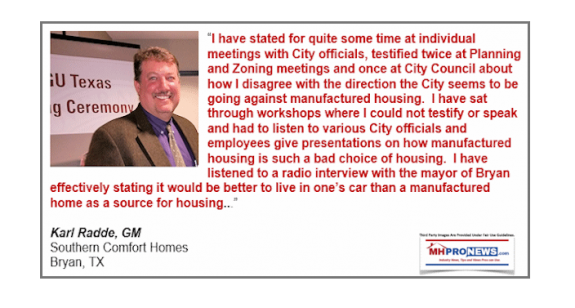
Karl Radde – TMHA, MHI, Southern Comfort Homes – Addressing Bryan City Leaders, Letter on Proposed Manufactured Home Ban
To All Concerned [Bryan City Officials, Others]: As the retail location referenced by Mr. Inderman, I would like to take a moment to address the …